Fleet charging at home, at work and on the road.
Home chargers, workplace equipment, energy tariffs and employee reimbursements can leave your team coordinating several suppliers and spreadsheets. Start with your existing setup and a clear plan for the records, responsibilities and connections you need.
The operating sequence
From connected assets to provable value.
Connect
Control
Settle
Prove
Optimise
Monetise
Charging coordination
Less work between the systems.
Different suppliers. Different records. One agreed process for charging costs, employee reimbursement and follow-up.
From separate tasks to a coordinated process.
- Without coordinationCharging records scattered. Costs reconstructed by hand.With ChargeControlAn agreed route for records and costs.Bring compatible data into the cost review.
- Without coordinationHome-charging reimbursements handled separately.With ChargeControlA structured reimbursement workflow.Use applicable tariffs and agreed approvals.
- Without coordinationSupplier hand-offs. Unclear next steps.With ChargeControlClear responsibilities and follow-up.Agree who supplies, checks and approves.
Catalogue specifications are a starting point, not confirmation of live connectivity or ERE eligibility. Compatibility depends on model, firmware, connection, available data and the service required.
Process example · not a customer case
35 EVs. Clear roles.
An illustrative fleet charging at home and at work. This explains the process, not a customer result or a quantified saving.
- Mobility team
- Gathers home and workplace charging sessions.
- Finance
- Reviews tariffs, reimbursement rules and approvals.
- Installer
- Checks equipment access and connection requirements.
- ChargeControl
- Supports the agreed connection and records workflow.
Coordination does not transfer responsibility.
Your team supplies charging records, tariffs, permissions and approvals. ChargeControl supports the agreed workflow; installers and suppliers remain responsible for their services. Your finance team and advisers assess the applicable tax treatment.
Reimbursement and ERE rights are separate. Reimbursing an employee does not establish ownership of their ERE rights. Data access and authority to act must be agreed; coordination alone grants neither.
How do you organise charging for an electric fleet?
Map three charging settings first: home, workplace and on the road. Then choose equipment, suppliers and policies that fit your usage. ChargeControl helps coordinate compatible systems, charging records and reimbursement processes; hardware, installation and energy supply remain separate services.
Home charging and reimbursement
Agree which business charging sessions are reimbursed, which tariff applies and who approves the records. Check that home chargers can supply usable meter and session data. ChargeBack supports an agreed reimbursement process; your finance team assesses the tax treatment.
Workplace and depot charging
Start with vehicle numbers, daily energy demand, departure times and available grid capacity. Use these to agree charger numbers and power with your installer. Smart charging depends on compatible equipment, integrations and site constraints; additional grid capacity is not automatically available.
Public charging and charging cards
Compare energy prices alongside session fees, subscriptions, roaming and any time-based charges. A charging card provides access and billing under its provider’s terms. Charging management also coordinates sites, records and reimbursements. ChargeControl does not promise universal card acceptance or the lowest tariff.
One Fleet Platform. Clear fees.
€4.99 per physical workplace/public charger per month + €1.99 per successful employee ChargeBack payout + 15% of realised gross ERE proceeds (you retain 85%). Excluding VAT.
ChargeControl Fleet Platform
Your fleet, in numbers.
€4.99 per physical workplace/public charger per month + €1.99 per successful employee ChargeBack payout + 15% of realised gross ERE proceeds (you retain 85%). Excluding VAT.
Optional. Leave blank to exclude payout fees; enter 0 for no payouts.
Payout fees excluded — count not supplied
- Annual station fees
- €59.88
- Annual payout fees
- Payout fees excluded — count not supplied
- ERE
- 998.082
- Gross ERE proceeds
- €149.71
- ERE service fee (15%)
- €22.46
- Retained ERE proceeds (85%)
- €127.26
- Total annual fees
- €82.34
- Annual net after platform fees
- €67.38
Indicative scenario, not a guaranteed return or verified supplier offer. €0.15 per ERE is editable. A 100% eligible-volume example is an assumption, not certification. Totals exclude payout fees unless the successful payout count is supplied.
Scope & assumptions
One station fee per physical charger, not per socket. No additional monthly station fee for fleet employee home charging. Consolidate employee payouts monthly where possible; failed payouts incur no fee. ERE requires verified eligibility and customer entitlement; third-party public charging is not automatically eligible. Energy, hardware, installation and third-party roaming charges are separate. New sales and explicitly agreed migrations only; existing contracts and standalone Home Pro remain unchanged.
ERE/kWh: 0.33269400000000005
Is this for your company?
A starting profile for a setup review—not an eligibility rule:
Catalogue specifications are a starting point, not confirmation of live connectivity or ERE eligibility. Compatibility depends on model, firmware, connection, available data and the service required.
ERE for fleets in one video
Why fleets do the scan
Assess possible ERE value after eligibility checks
ERE is an optional route after metering, registration, ownership and authority to act have been checked. A MID meter alone does not establish eligibility. Verification and realised market value determine any proceeds.
Start with existing equipment
The assessment checks your existing equipment and metering. A MID meter alone does not establish ERE eligibility. Hardware and installation are quoted separately.
Clear responsibilities for the records
Your team supplies charging records, tariffs, permissions and approvals. ChargeControl supports the agreed workflow; installers and suppliers remain responsible for their services. Your finance team and advisers assess the applicable tax treatment.
Start an indicative ERE assessment.
Tell us about your charge points, metering and charging situation. The assessment identifies information and checks needed for a possible registration route. It is not confirmation of eligibility, free installation or future proceeds.
Scenario assumption: €0.15 per ERE and 100% of sessions counted. This does not mean 100% renewable electricity or verified eligibility. The example for delivery year 2026 uses 0.505 × 0.6588 = 0.332694 ERE/kWh, or €0.0499041 gross per kWh. Actual issuance and value follow scheme and market conditions.
Run the numbers yourself with our free tools
Instant results, no data needed, no strings attached.
Estimate what the charging you already do could earn via ERE certificates.
The business case for electrifying your fleet.
Size and cost your depot charging infrastructure.
Questionnaire showing how ready your fleet is to go electric — with an advice report.
See what you get
See a sample report
A calculator result is an instant illustration based on inputs and assumptions, not a reviewed report. An assessment may need additional records and checks; report timing is confirmed during follow-up.
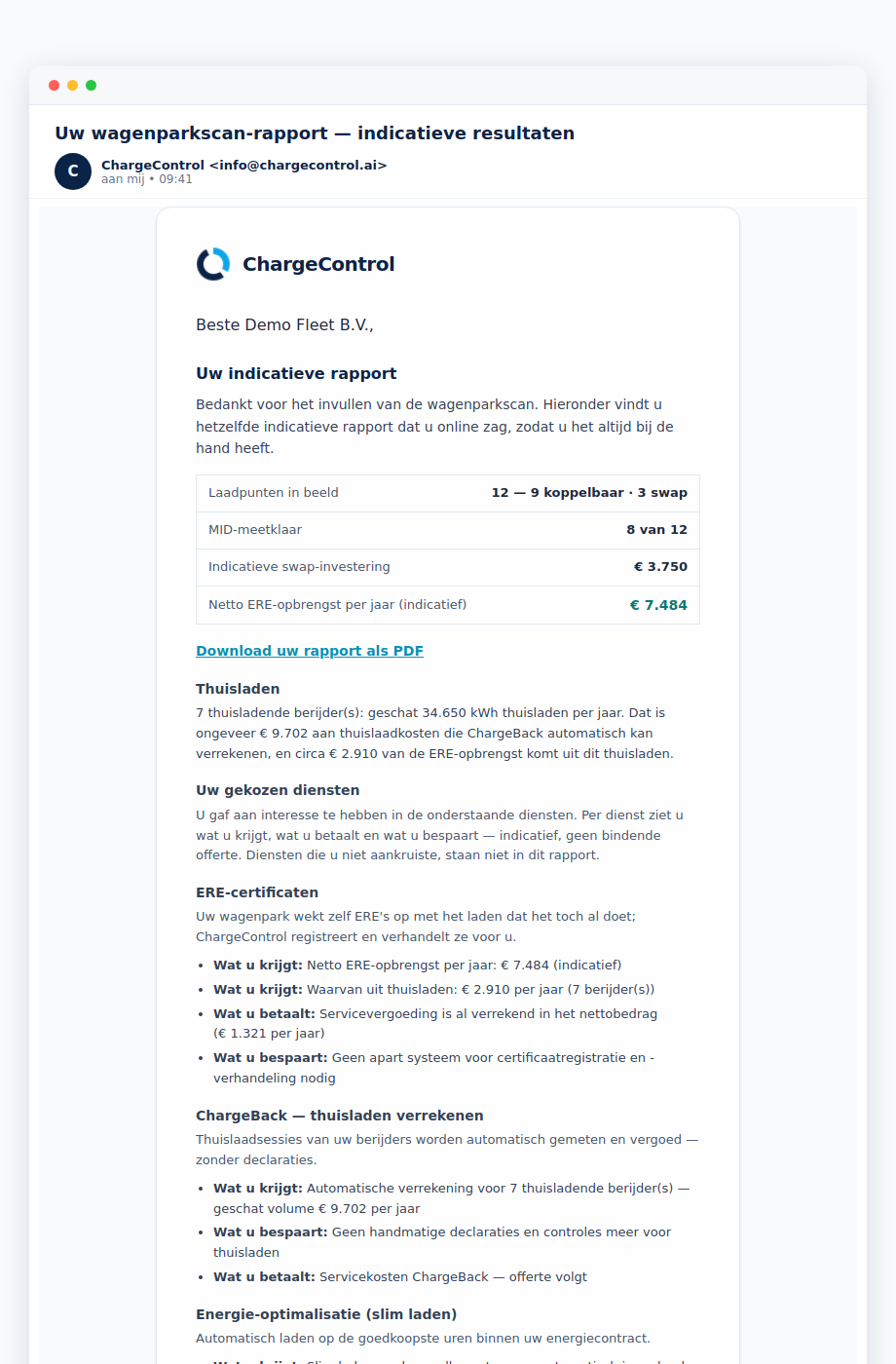
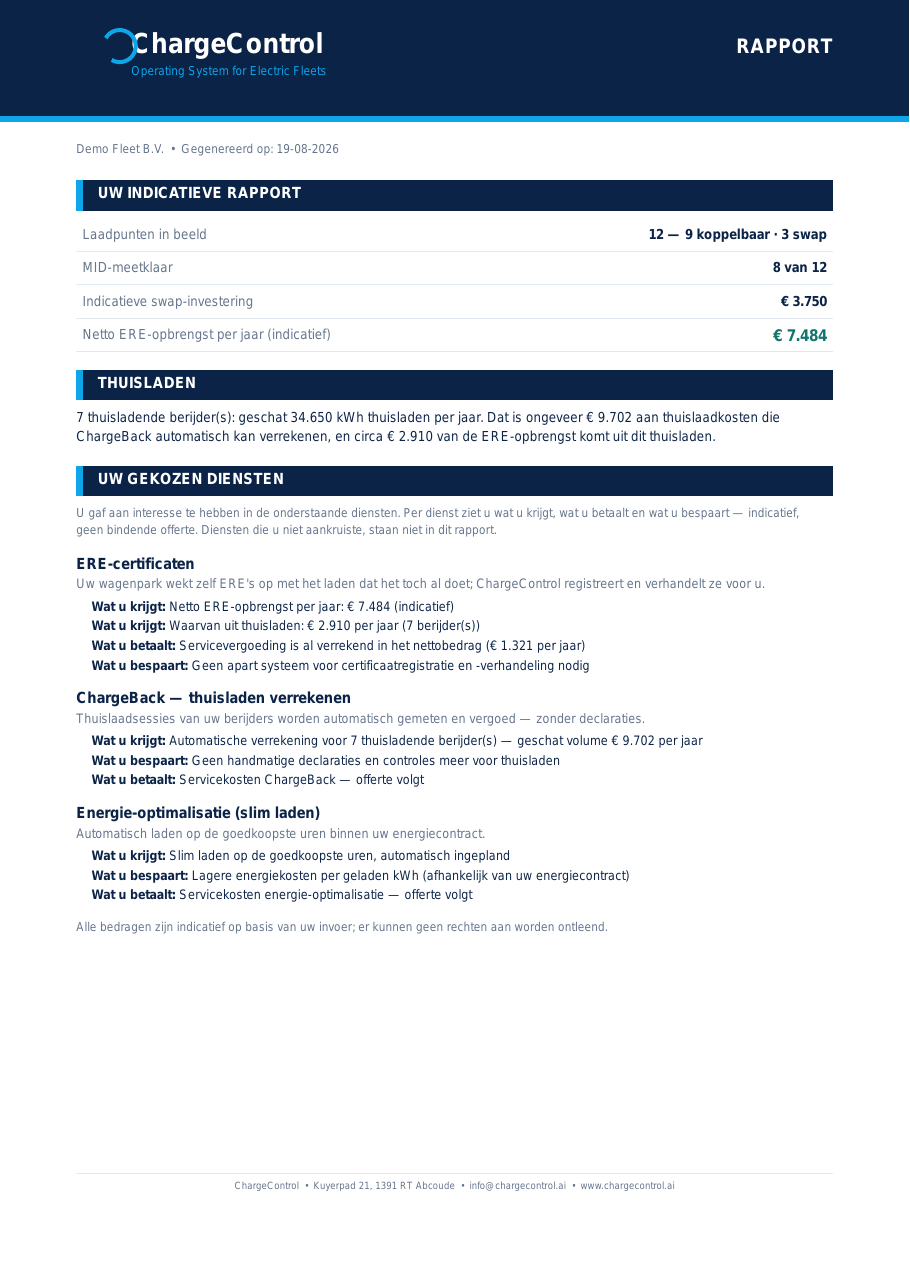
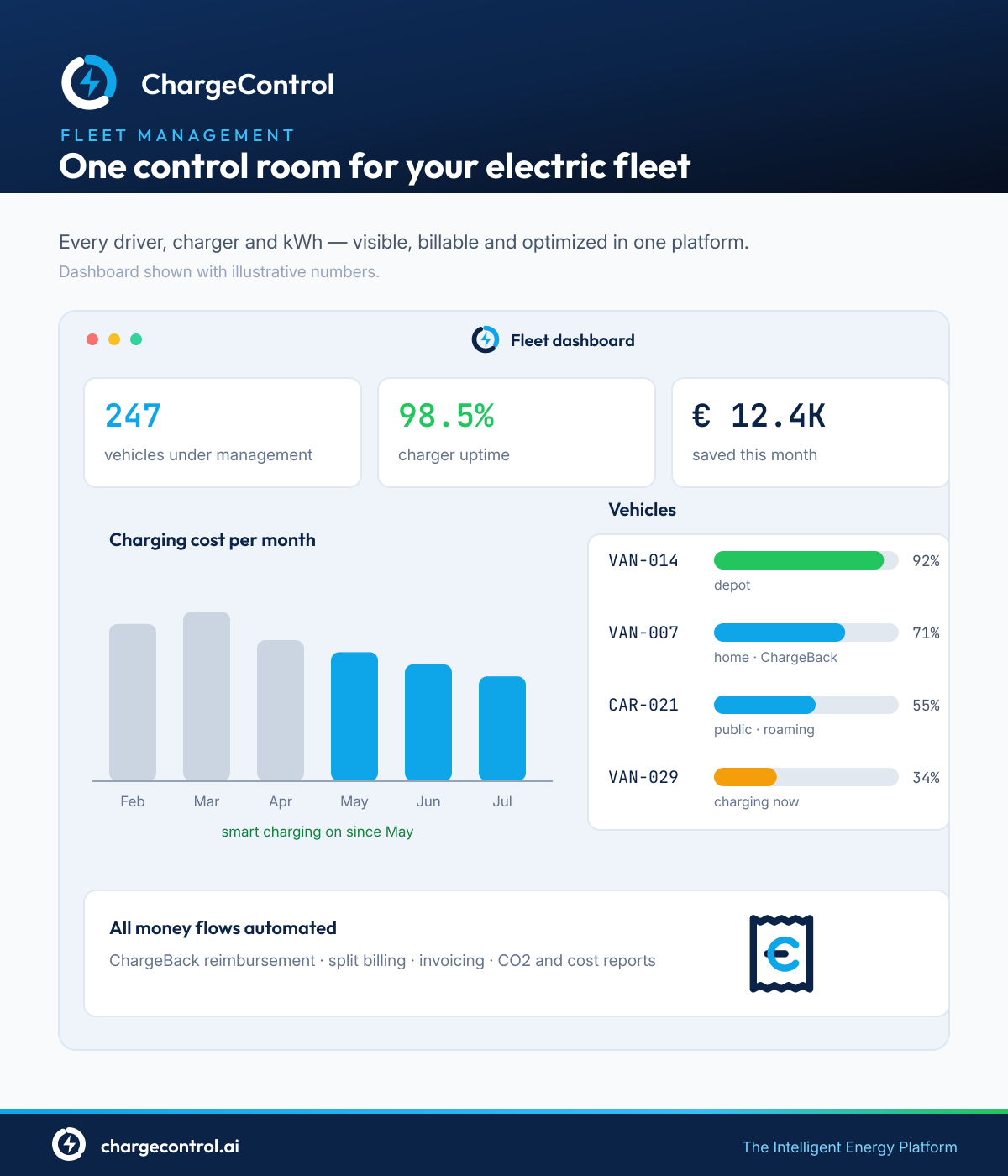
The figures shown are illustrative demo examples, not guarantees.
Frequently asked questions
Review my fleet setup
Home chargers, workplace equipment, energy tariffs and employee reimbursements can leave your team coordinating several suppliers and spreadsheets. Start with your existing setup and a clear plan for the records, responsibilities and connections you need.
Share the scan — €25 per new ERE customer, €150 per fleet customer
Rewards run through your personal link, which you get after the free scan. Do the scan first — then share your link and earn €25 per new ERE customer and €150 per fleet customer.